
How to Design Your Sales Follow-Up Cadence
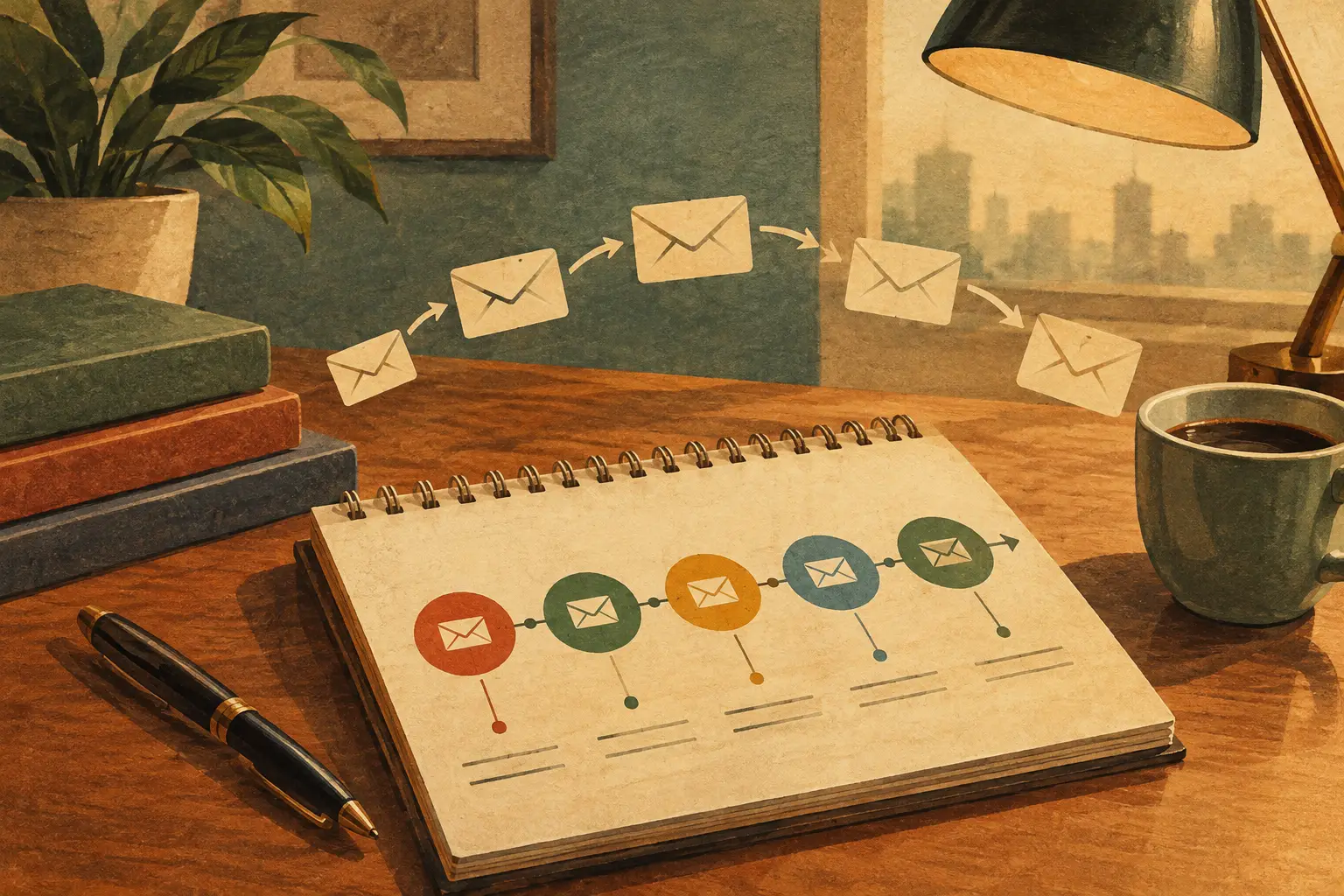
A corporate buyer who does not reply to your first email has not necessarily rejected you. More often, they are managing a crowded inbox, a pressing internal priority, or a message that arrived before the problem became urgent. The firms that create consistent sales conversations understand this: a design sales follow-up cadence is not a persistence contest. It is a controlled process for creating relevant, credible reasons to respond.
For high-ticket consultants, advisors, and professional service firms, the stakes are higher than they are in commodity sales. One poorly timed or generic follow-up can make a senior decision-maker associate your firm with noise. One well-researched, well-paced sequence can put you in front of the right buyer when a real business need surfaces.
Why most follow-up systems fail
Most follow-up failure comes from one of two extremes. The first is sending one thoughtful email, receiving silence, and moving on. The second is sending a string of nearly identical "just checking in" messages until the prospect disengages or marks the sender as spam.
Neither approach respects how enterprise and corporate buying decisions happen. Senior leaders rarely book a meeting because a stranger asked twice. They respond when the outreach connects a credible point of view to a problem they recognize, a priority they own, or an outcome they are measured against.
Your cadence must therefore do three jobs at once: preserve familiarity, add value with each touch, and maintain a professional distance. The goal is not maximum activity. It is the right number of meaningful opportunities for a qualified buyer to engage.
Start with deal value and buying complexity
There is no universal number of touches that works for every offer. A consultant selling a $35,000 leadership program to a VP of People needs a different sequence than an IT services firm selling a six-figure transformation engagement to a CIO.
As deal value and the number of stakeholders increase, a longer cadence usually makes sense. Corporate buyers may need time to validate the problem internally, align budget, or wait for an existing vendor contract to expire. That does not mean you should send more messages without purpose. It means each follow-up needs a distinct strategic role.
Before building a sequence, define three points. First, clarify the specific business problem your offer solves. Second, identify the executive who feels the consequences of that problem most directly. Third, determine the event or trigger that makes the issue timely, such as a merger, growth target, hiring push, leadership change, or operating-model shift.
This work is what separates senior-level business development from automated outreach that merely inserts a first name. If the relevance is weak, cadence will not fix it.
Design a sales follow-up cadence around momentum
For most high-ticket B2B offers, a six- to eight-touch sequence over roughly three to four weeks is a disciplined starting point. It gives the prospect enough exposure to recognize your name without turning your outreach into a recurring interruption.
The timing should not be perfectly uniform. Early touches can be closer together because the first email is still fresh. Later touches should create more space, especially when you are asking a senior buyer to consider a strategic conversation.
Touches one and two: Establish relevance
The first message earns attention with specificity. It should reference a business context that plausibly matters to the prospect and connect it to a clear outcome you help create. Keep the request simple: ask whether the issue is on their agenda, or whether a short conversation would be useful.
The second touch, typically two to three business days later, should not repeat the first email. Add a sharper observation, a relevant question, or a concise example of the cost of inaction. You are demonstrating that your outreach was intentional, not automated at scale.
For example, a leadership consultant might follow an initial message about management capability during rapid growth with a second note about the hidden cost of newly promoted leaders receiving inconsistent coaching. The buyer now has a different lens through which to assess the problem.
Touches three and four: Change the angle
By the third message, shift from the original pain point to an adjacent concern. If your first message focused on revenue leakage, the next might address execution risk, client retention, or leadership time lost to an inefficient process.
This is where research-first personalization earns its keep. A prospect's role, company strategy, team structure, public initiatives, and market position can all inform a fresh angle. The message does not need to be long. In fact, concise is usually stronger. It simply needs to give the buyer a new reason to think, "This may apply to us."
The fourth touch can use a different channel if that channel is appropriate for the account. A measured LinkedIn connection request or a brief follow-up message can reinforce familiarity. Do not copy and paste the email into LinkedIn. Treat each channel as part of one coordinated conversation, not as another place to pursue the same person.
Touches five and six: Reduce friction
As the sequence progresses, lower the commitment required to respond. Instead of repeatedly asking for a 30-minute meeting, offer a useful choice: is this a priority for this quarter, later in the year, or not relevant? You can also ask whether another executive owns the issue.
This approach performs well because it makes replying easy and gives the prospect control. A "not now" response is still valuable intelligence. It creates a legitimate reason to re-engage at a more appropriate time, rather than forcing a cold lead through a sequence that no longer fits.
Your sixth touch can briefly address the reason you are reaching out in the first place. State the outcome you help clients achieve, who you typically help, and why you believed the prospect was a potential fit. This is not a pitch deck in email form. It is a clean positioning statement that makes your relevance easy to evaluate.
The final touch: Close the loop with authority
A final follow-up should be calm and direct. Tell the prospect you will close the loop for now and invite them to reconnect if the priority changes. Do not use false scarcity, frustration, or guilt.
A professional close-the-loop note protects your reputation while giving the buyer a final chance to reply. It also prevents your team from spending endless time on prospects who are not currently engaged. High-value outbound is as much about disciplined disqualification as it is about booking meetings.
Match cadence to channel and deliverability
A sound sequence can fail if technical operations are careless. Sending too many emails from one inbox, relying on poorly configured domains, or increasing volume too quickly can damage deliverability and undermine every message in the campaign.
For that reason, cadence design must account for sending infrastructure. Dedicated sending domains, properly authenticated mailboxes, controlled volumes, and real-time monitoring give your outreach room to perform without risking your primary brand domain. The buyer never sees this operational work, but they experience its result: your message reaches the inbox and looks like it came from a credible peer.
Channel choice also depends on the buyer. Email is usually the primary channel for a detailed, business-focused message. LinkedIn can reinforce recognition, particularly when the profile and connection note reflect the same level of professionalism. Phone can be effective for certain industries, but only when the offer, list quality, and caller capability justify it. Adding channels simply to raise touch count is wasteful.
Measure replies, not just activity
Open rates are no longer a reliable measure of interest. Track positive replies, qualified conversations, booked consultations, show rates, and eventual pipeline value. Then review performance by segment, title, industry, message angle, and touch number.
If your positive replies arrive mostly after touch three, your first email may need a stronger value proposition or a more compelling reason to care. If prospects reply but do not book, your call to action may be too broad or your qualification may be off. If response rates decline as volume rises, investigate list quality, personalization depth, and deliverability before rewriting the whole campaign.
A strong system also records objections. "We already have a provider," "not a priority," and "contact me in Q4" are not dead ends. They are signals that should shape future messaging, timing, and account prioritization.
Keep follow-up human, even when it is managed at scale
Automation should handle the repetitive operational work: task timing, inbox rotation, reporting, follow-up status, and reminder logic. It should not replace judgment. A prospect who replies with a nuanced question deserves a thoughtful human response, not an automated branch that ignores what they said.
That is the standard AIgenticc applies to managed outreach: use systems to create consistency, then use research and judgment to preserve authority. For premium services, the message is part of the sales experience. Every follow-up should make a corporate buyer more confident that a conversation with you would be worth their time.
Build your cadence with enough structure to eliminate missed opportunities, but enough restraint to protect the reputation you have spent years earning.